Understanding the steel tip 501 rules overview is crucial for anyone looking to enjoy a competitive and standardized game of darts. This article provides a complete steel tip 501 rules overview, covering everything from scoring and starting procedures to winning strategies, ensuring you’re well-equipped for your next match.
⚠️ Still Using Pen & Paper (or a Chalkboard)?! ⚠️
Step into the future! The Dart Counter App handles all the scoring, suggests checkouts, and tracks your stats automatically. It's easier than you think!
Try the Smart Dart Counter App FREE!Ready for an upgrade? Click above!
Comprehensive Steel Tip 501 Rules Overview: Getting Started
Steel tip 501 is one of the most popular and widely played dart games around the globe. It’s a simple yet challenging game that tests your accuracy, strategy, and mental fortitude. This section breaks down the fundamental aspects of the game to get you started.
The Basic Setup
Before you can start playing, you need to ensure your dartboard is properly set up. Here’s what you need to know:
- Dartboard Height: The center of the bullseye should be exactly 5 feet 8 inches (1.73 meters) from the floor.
- Throwing Distance: The oche (throwing line) should be 7 feet 9 1/4 inches (2.37 meters) from the face of the dartboard.
- Dartboard Positioning: Make sure the number 20 is at the top of the dartboard.
These measurements are crucial for fair play and are standardized across most professional and amateur games. Getting them right ensures a consistent and accurate playing experience.
How to Begin a Game of 501
The game begins with each player (or team) starting with a score of 501 points. The goal is to be the first to reduce your score to exactly zero. However, there are some specific rules regarding how you can start and finish a leg of 501.
Typically, a “double in” rule is *not* required, meaning you can score points from your very first dart thrown. However, this can be modified for house rules, especially to make the game more challenging, so check with your fellow players beforehand. Starting with a double does add an extra layer of strategy and precision, forcing players to aim for specific targets right from the start.
Scoring in Steel Tip 501
Understanding the scoring system is obviously vital. Darts can land in various sections of the dartboard, each carrying a different point value.
Understanding the Board Sections
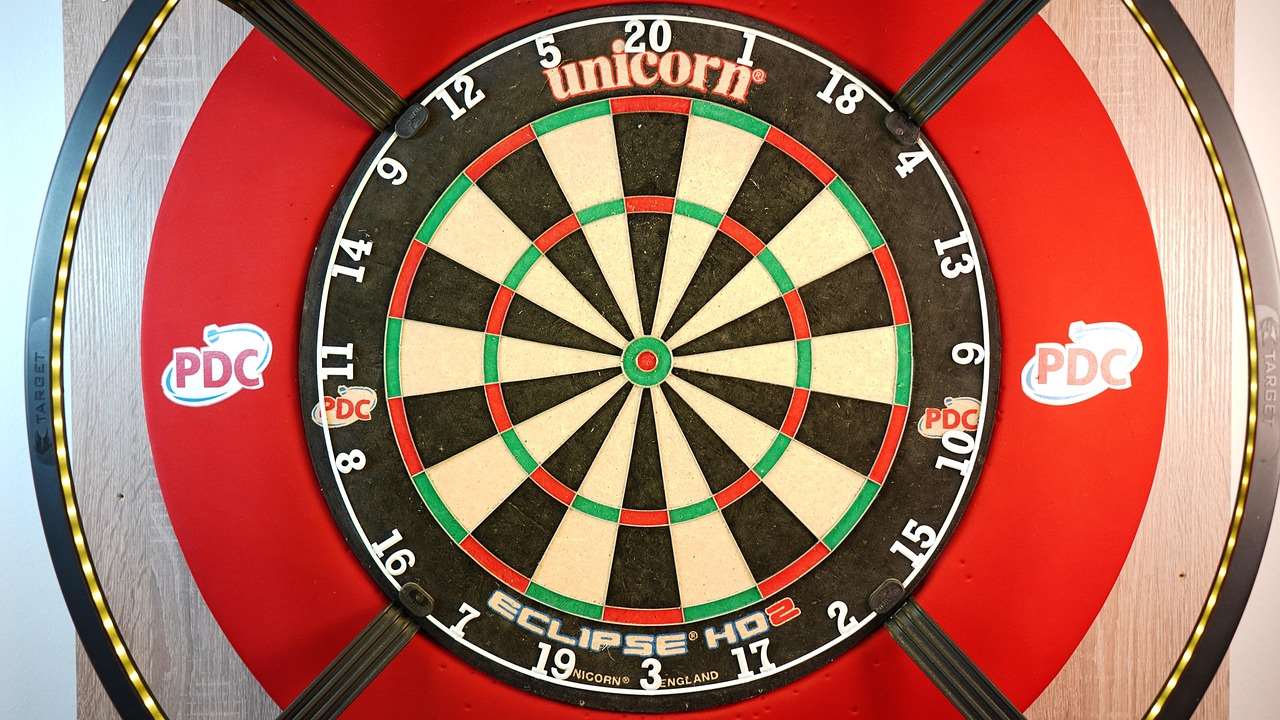
The dartboard is divided into several scoring sections:
- Single Numbers: The large areas between the wires are worth the number displayed on that section.
- Double Ring: The outer ring doubles the value of the corresponding number. For example, hitting the double 20 scores 40 points.
- Treble Ring: The inner ring triples the value of the corresponding number. Hitting the treble 20 scores 60 points.
- Bullseye: The outer green ring (outer bull) scores 25 points, while the inner red bullseye (bull) scores 50 points.
Accurately aiming for these sections is key to reducing your score quickly. Remember to call your score after each turn to ensure everyone is on the same page.

Calculating Your Score
After each throw of three darts (or less, if you are finishing), you need to calculate your total score for that round and subtract it from your remaining total. Keeping a running total is essential. You can do this manually, use a scoreboard, or use a darts scoring app. Incorrect scoring can lead to confusion and potentially cost you the game.
For example, if you have 161 remaining, and you throw a treble 20 (60), a 20 (20), and a treble 17 (51), your total for that round is 131. You would then subtract 131 from 161, leaving you with 30.
Finishing the Game: The Double Out Rule
The most crucial rule to grasp within the steel tip 501 rules overview is the “double out” rule. This rule adds a layer of strategic thinking to the game.
What is the Double Out?
To win a leg of 501, you must finish on a double. This means that the final dart you throw must land in the double ring of a number that reduces your score to exactly zero. Hitting the bullseye (50) also counts as a double (double 25).
For instance, if you have 40 remaining, you need to hit the double 20 to win. If you hit a single 20, leaving you with 20, you then need to hit the double 10 to win. If you overshoot and hit a treble 20 instead, you “bust” and your score reverts to what it was at the start of that turn.

Busting: When Things Go Wrong
A “bust” occurs when you reduce your score to one, zero without hitting a double, or go below zero. If you bust, your turn ends immediately, and your score reverts to what it was before you threw your first dart in that turn. This can be frustrating, but it’s a key part of the game and requires careful planning.
For example, if you have 32 remaining and you hit a treble 8 (24), leaving you with 8, you cannot win on that throw. You would need to hit a single 8 to leave yourself on double 4. If instead, you then threw a single 8 on your *next* throw, you would still have to end with a double. If you only needed to end with a single, instead of a double, you could try alternative darts rules for home play for a change of pace.
Common Finishing Combinations
Knowing common finishing combinations can significantly improve your game. Here are a few examples:
- 32: Double 16
- 40: Double 20
- 50: Bullseye
- 60: Treble 20 (followed by a double to checkout on the remaining balance)
Practicing these combinations will make you a more confident and strategic player. If you are brand new to darts, you might consider focusing on Basic Darts Fundamentals for Beginners until you have the basics down.
Steel Tip 501 Rules Overview: Game Variations and Strategies
While the basic rules remain consistent, there are some common variations and strategic approaches you can incorporate into your game.
“Double In” Variations
As mentioned earlier, some variations of 501 require a “double in.” This means you must start the game by hitting a double before you can begin scoring. This variation adds another layer of difficulty and requires more precise throwing right from the start. It is usually reserved for more advanced players.

Team Play
501 can be played in teams, adding a social element to the game. Teams usually alternate turns, with each player throwing three darts per turn. Team play requires good communication and strategy, as you need to coordinate your throws to set up your teammates for finishes. Consider creative dart rules for parties and social gatherings for even more fun.
Handicap Systems
To make the game fairer for players of different skill levels, you can implement a handicap system. This might involve giving weaker players a head start by reducing their starting score, or requiring stronger players to finish on a higher double. This ensures that everyone has a chance to compete and enjoy the game. Sometimes figuring out How to make darts fairer with handicap rules can be tricky, but it’s worth it.
Tips for Improving Your 501 Game
Improving at 501 requires practice, patience, and a strategic mindset. Here are some tips to help you elevate your game:
Practice Regularly
Consistent practice is key to improving your accuracy and consistency. Set aside time each week to practice your throws and focus on hitting specific targets. The more you practice, the more natural your throwing motion will become.
Focus on Your Grip and Stance
Experiment with different grips and stances to find what works best for you. A comfortable and consistent grip is essential for accurate throwing. Your stance should be balanced and stable, allowing you to maintain control throughout your throw.
Develop a Pre-Throw Routine
A pre-throw routine can help you focus and maintain consistency. This might involve taking a deep breath, visualizing your target, and going through the same throwing motion each time. A consistent routine can help you stay calm and focused under pressure.

Analyze Your Game
Pay attention to your performance and identify areas where you can improve. Are you consistently missing a particular target? Are you struggling to finish on doubles? By identifying your weaknesses, you can focus your practice on those areas and improve your overall game. Consider trying out fun dart game variations with modified rules to shake things up.
Mental Toughness
Darts is as much a mental game as it is a physical one. Staying calm and focused under pressure is crucial for success. Learn to manage your emotions and avoid getting discouraged by missed throws. A positive attitude and a strong mental game can make a big difference in your performance.
Advanced Strategies for Steel Tip 501 Rules Overview Mastery
Once you have a solid grasp of the basics, you can start incorporating more advanced strategies into your game. Here are a few to consider:
Target Priority
Develop a target priority strategy. This involves identifying the most strategic targets to aim for based on your remaining score and your opponent’s position. For example, if you have a high score remaining, you might prioritize hitting treble 20s to reduce your score quickly. If you’re close to finishing, you might focus on setting yourself up for a double.
Blocking Strategies
Blocking involves throwing your darts in a way that makes it difficult for your opponent to score. For example, if your opponent is close to finishing on a particular double, you might throw your darts near that double to make it harder for them to hit it. This can disrupt their rhythm and give you a strategic advantage.
Calculating Outs Under Pressure
Master the art of calculating outs quickly and accurately. This involves being able to quickly assess your remaining score and identify the best combination of throws to finish the game. Practice mental math and familiarize yourself with common finishing combinations. This skill will be invaluable under pressure.
Reading Your Opponent
Pay attention to your opponent’s body language and throwing patterns. Are they showing signs of nervousness? Are they consistently aiming for a particular target? By reading your opponent, you can gain valuable insights into their strategy and adjust your own game accordingly.
Conclusion
Mastering the steel tip 501 rules overview and associated strategies opens the door to a world of competitive and engaging dart play. From understanding the basic setup and scoring to mastering the double-out rule and incorporating advanced tactics, this guide provides a comprehensive foundation for success. Remember that consistent practice, strategic thinking, and mental fortitude are key to elevating your game. Now, grab your darts, step up to the oche, and put your newfound knowledge to the test. Why not start by reviewing Simplified 501 game rules for novice players? Go out there and aim for that winning double!

Hi, I’m Dieter, and I created Dartcounter (Dartcounterapp.com). My motivation wasn’t being a darts expert – quite the opposite! When I first started playing, I loved the game but found keeping accurate scores and tracking stats difficult and distracting.
I figured I couldn’t be the only one struggling with this. So, I decided to build a solution: an easy-to-use application that everyone, no matter their experience level, could use to manage scoring effortlessly.
My goal for Dartcounter was simple: let the app handle the numbers – the scoring, the averages, the stats, even checkout suggestions – so players could focus purely on their throw and enjoying the game. It began as a way to solve my own beginner’s problem, and I’m thrilled it has grown into a helpful tool for the wider darts community.